
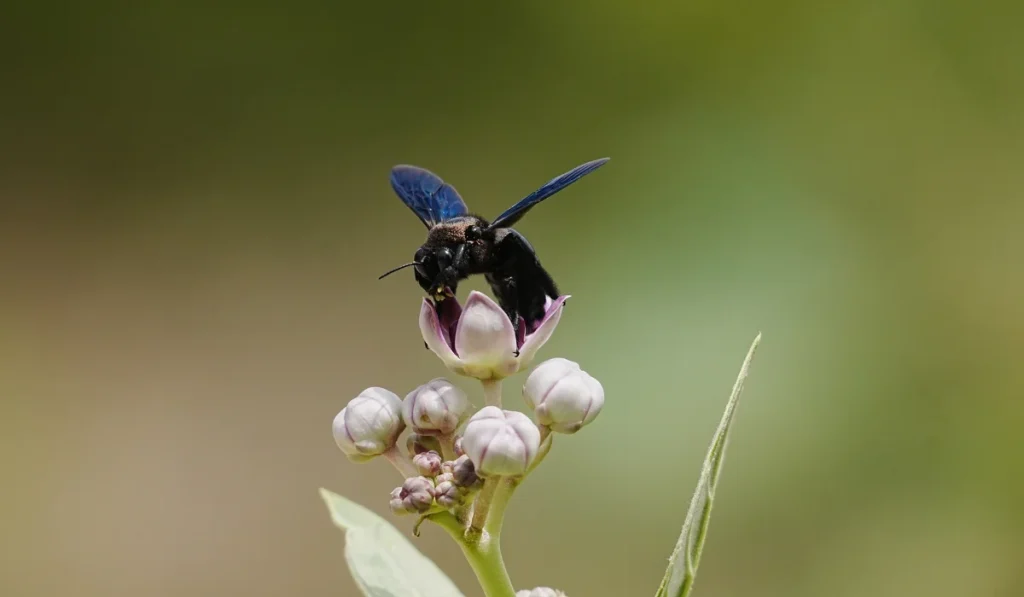
You see a large bee circle the same patio beam, disappear beneath a railing, then return a few minutes later. When you check the wood, there is a clean round hole with fresh sawdust below it. Those clues often point to California carpenter bees using the wood as a nesting site.
Carpenter bees are native pollinators, but females also excavate wood for their nests. If you know what the bees, carpenter bee holes, and fresh wood damage look like, you can tell when ordinary backyard activity has turned into a problem worth addressing.
How to Identify California Carpenter Bees
California is home to three carpenter bee types commonly known as the Valley carpenter bee, California carpenter bee, and mountain or foothill carpenter bee. They do not all look alike, and even males and females of the same type can look surprisingly different.
Female Valley carpenter bees are large and black. Males are golden brown or blond, with noticeable green eyes. California carpenter bees can show bluish metallic reflections, while mountain or foothill carpenter bees are smaller than the other two.
Carpenter Bee or Bumblebee?
From across the yard, a carpenter bee can easily look like a bumblebee. Once you get a safe look, check the abdomen. Carpenter bees usually have a smoother, shinier section, while bumblebees look fuzzier across more of the body.
Where the insect goes is even more useful. A large bee repeatedly entering a clean opening in a fence, fascia board, pergola, railing, or exposed beam gives you a strong clue that you are looking at a carpenter bee nest rather than a bee simply visiting flowers.
| What You Notice | Carpenter Bee | Bumblebee |
|---|---|---|
| Abdomen | Has a smooth, shiny area | More densely covered with hair |
| Nest location | Excavates galleries in wood | Uses an existing protected cavity |
| Activity near lumber | May return to one round opening | Does not normally bore into sound wood |
| Social behavior | Primarily solitary | Lives in colonies |
| Useful homeowner clue | Hole, sawdust, and repeated entry | Bees entering an existing cavity or ground nest |
Color alone is not enough for identification. Watch the flight path and inspect the wood. Those details usually tell you more than body color from several feet away.
What Carpenter Bee Activity Looks Like Around Your Home
A fresh carpenter bee entrance can look almost drilled. Instead of a ragged break in the surface, you may find a smooth circular opening on the underside, edge, or sheltered face of a board. These round holes in wood are one of the most recognizable signs of active nesting.
Fresh debris helps narrow it down further. Females remove wood as they excavate, so sawdust below holes can appear on a patio floor, deck, railing, or soil beneath the affected board. If you also see a bee returning to the same opening, the chance of an active carpenter bee nest goes up.
| Sign You Find | What It Suggests | Where to Look Next |
|---|---|---|
| Clean round hole | Possible carpenter bee entrance | Watch the opening from a safe distance |
| Fresh sawdust | Recent excavation | Check the wood directly overhead |
| Several nearby holes | Repeated nesting in the same area | Inspect the entire board or beam |
| Yellowish or dark staining | Past or current entrance activity | Look for fresh debris and bee traffic |
| Ragged damage beside a round hole | Possible bird damage | Check for original entrances nearby |
| Bare, weathered wood | More favorable nesting surface | Inspect ends, edges, and protected undersides |
Check These Parts of the House First
Start where exposed wood stays fairly dry. Eaves, exposed rafters, fascia, patio covers, pergolas, deck framing, wooden railings, sheds, and fences are common places to inspect. Board ends and underside surfaces deserve a close look because they can remain unfinished even when the visible face is painted.
Redwood is especially relevant in California homes. It appears in fencing, decks, arbors, and other outdoor structures throughout the state. The UC Statewide IPM lists California redwood, cedar, Douglas fir, cypress, white pine, and southern yellow pine among woods that carpenter bees may use.
Untreated wood and weathered wood deserve more attention than a well-maintained painted surface. An old hole may remain visible after activity ends, so focus on fresh sawdust, new staining, repeated flights, or recently made carpenter bee holes.
What Happens Inside a Carpenter Bee Nest
The opening you see is only the doorway. A female enters the wood, turns, and continues excavating a nesting gallery inside the board. She divides the tunnel into brood chambers, then places an egg and stored pollen in each one.
Most of the carpenter bee nest stays hidden. A piece of lumber can look nearly normal from outside apart from one small entrance, even though several inches of wood gallery extend behind the surface.
| Nest Detail | Verified Figure | What It Means for You |
|---|---|---|
| Female body length | About 5/8 to 1 inch | Explains the bee’s noticeably large size |
| Typical gallery diameter | About 1/2 inch | Helps put the entrance size in context |
| Typical gallery depth | About 6 to 10 inches | Shows how far a normal nest may extend |
| Egg to adult development | About 3 months | Young can remain inside after visible activity changes |
| Generations | 1 per year | Nesting follows an annual reproductive cycle |
| Heavily reused tunnel system | Up to about 10 feet | Years of expansion can create larger wood galleries |
Why Old Wood Galleries Matter
Carpenter bees can reuse old tunnels. A female may enlarge an existing gallery rather than start from untouched wood, and several branches can develop around the same entrance over time.
That is how carpenter bee damage can build quietly. The 10-foot figure sometimes associated with these nests refers to heavily reused tunnel systems that have expanded over multiple nesting cycles. A fresh nest is usually much shorter.
Counting openings also has limits. One entrance does not always equal one short tunnel, especially when California carpenter bees return to the same wooden structure year after year.
How Much Carpenter Bee Damage Can Occur?
One hole in a solid fence post usually does not mean the wood is about to fail. Severe carpenter bee damage is uncommon in ordinary conditions. The concern rises when the same section of lumber collects more galleries across several seasons.
Where the holes appear matters. Repeated bee damage to wood in decorative fencing may be mostly a repair issue. Several galleries in a thin fascia board, railing connection, roof component, or structural timber deserve a closer look because less intact wood remains around each tunnel.
Woodpeckers Can Make the Damage Worse
Sometimes the roughest damage around a carpenter bee infestation comes from another animal. Woodpeckers can recognize that larvae are inside the wood and break open the galleries while trying to reach them. The result looks much rougher than the original carpenter bee hole.
Cornell Integrated Pest Management describes entrance holes around ⅜ to ½ inch across and notes that woodpeckers may enlarge the damage while searching for developing bees.
If you find gouged wood near an otherwise clean hole, inspect the rest of the board. You may find more entrances nearby.
Carpenter Bees and Termites Leave Different Evidence
Carpenter bees excavate wood to make nesting space. They do not eat it. Termites feed on cellulose, so their damage develops for a different reason and often looks different around the home.
A large bee entering a clean hole with fresh sawdust beneath it points toward carpenter bee activity. Mud tubes, discarded termite wings, or widespread internal feeding damage point in another direction. Correct identification should come before carpenter bee treatment or any other pest-control work.
Are Carpenter Bees Dangerous?
A large bee flying directly toward you can feel aggressive, especially when the nest is close to a doorway, patio, or deck. The bee doing the hovering is often a male defending a small area near the nest.
Male carpenter bees cannot sting. Females can, but they are generally reluctant to sting unless they are handled, trapped, or strongly provoked. Give an active opening some room and watch it from a safe distance instead of reaching toward it.
Not Every Carpenter Bee Needs Control
A carpenter bee moving between flowers is doing normal pollinator work. Native bees play an important role in gardens and landscapes, so seeing one around flowering plants does not automatically call for carpenter bee control.
The reason to consider action is repeated nesting in wood you need to protect. If there are no carpenter bee holes, no fresh debris, and no nesting activity around the structure, there may be nothing to treat.
This distinction helps keep carpenter bee control focused. You are dealing with a property issue, not simply reacting to the presence of a pollinator.
How to Prevent Damage and Know When to Call
Paint or varnish can make exposed lumber less attractive for nesting. Keep finishes in good condition and include board ends, edges, and other surfaces that are easy to overlook. Filling cracks and depressions also removes convenient starting points for wood-boring bees.
Do not seal an opening the moment you find it. Adults or developing young may still be inside the gallery. Closing an active nest too early can trap bees or cause them to create another exit. Wait until the carpenter bee nest is inactive before repairing the hole and refinishing the wood.
Professional carpenter bee control becomes more useful when fresh holes keep appearing, bees return to the same structure each season, or galleries are high, difficult to reach, or located in important structural wood. A technician can confirm whether the activity is current, look for additional nesting nearby, and help determine whether carpenter bee treatment is needed before repairs begin.
If you are seeing repeated California carpenter bees, fresh sawdust, or new holes around your home, Round the Clock Pest Services can inspect the affected area and help you decide what needs treatment, repair, or monitoring. Contact Round the Clock Pest Services to have the activity identified before more galleries develop.