
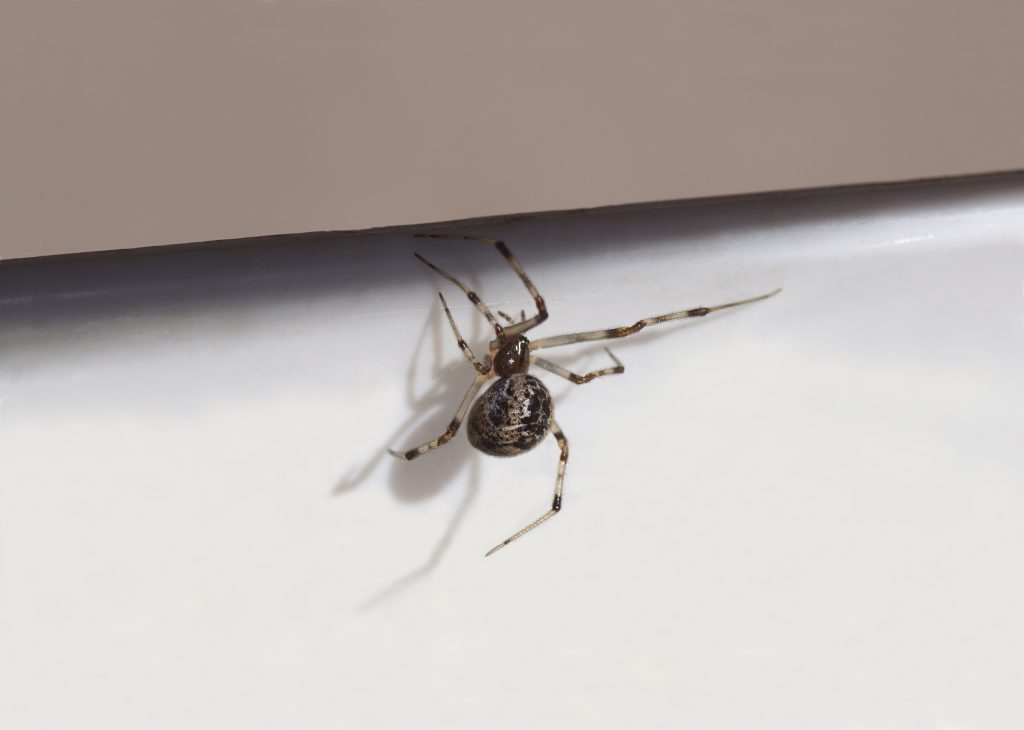
You reach into a garage storage area and notice a small spider in the same ceiling corner where it sat last week. The silk has spread farther along the wall, but the spider has hardly changed position. That common house spider stays close because the web is already doing its job. It catches insects, provides cover, and carries vibrations directly to the spider when prey lands.
The spider may leave after the silk gets damaged, food becomes scarce, or the area grows too busy. It usually does not travel far before building again. That short move can leave several dusty cobwebs in one room and make a small problem look larger than it is. This guide explains common house spider behavior, identification, egg sacs, bite risk, and the changes that help stop webs from returning.
Why the Common House Spider Stays Near Its Web
A common house spider web functions as both a trap and a shelter. When a gnat, moth, fly, or another small arthropod strikes the silk, the impact travels through the strands. The spider detects that movement and approaches the prey without crossing an exposed floor or wall.
A working web saves energy. Leaving it means producing more silk and testing a location that may catch nothing. An established female has even more reason to remain nearby when the web contains food or egg sacs.
You may not see the spider every time you check the corner. It can wait in a darker section of silk or retreat into a narrow crack beside the web. Once the room becomes quiet, it may return to the visible strands.
Where House Spider Webs Usually Appear
The best web sites combine shelter, firm attachment points, and regular insect traffic. A garage ceiling joint often works better than a cabinet that opens several times each day. Window frames attract small insects moving toward light, while shelving and crawl spaces give the spider protection from cleaning.
| Common Web Site | Why It Works | What You May Notice |
| Garage door tracks and ceiling joints | Insects enter when the door opens | Fresh silk near lights or upper corners |
| Window frames | Flies and gnats gather near light | Webs beside glass or damaged screens |
| Storage shelving | Boxes shield the web from disturbance | Dusty cobwebs behind containers |
| Crawl spaces | The area stays dark and quiet | Webs along pipes, vents, or floor joists |
| Porch ceilings and eaves | Fixtures attract flying insects | Webs near bulbs, trim, or entry doors |
The spider is not attached to one room. It stays because that location continues to provide food and protection with little effort.
Why a Common House Spider Leaves One Web
A common house spider does not remain in its first web for life. A broom may catch the outer strands. A storage bin can scrape the wall. Wind or rain may reach a sheltered porch corner. Minor damage can be repaired, but repeated disturbance often sends the spider to another protected site.
The Penn State Extension notes that these spiders may abandon one web and build another nearby. That behavior explains why several empty cobwebs can appear along one wall even when only one spider has been active.
The Web Stops Catching Insects
A web loses value when insect activity changes. Repairing a window screen may cut off the flies that once reached the silk. A porch light that no longer operates may stop drawing moths. The spider may shift toward another doorway, fixture, or window where prey remains available.
Recurring webs can reveal a separate pest issue. Silk near a sink may point to small flies. Webs around pantry shelving can appear near moth activity. A web that keeps forming near the lower corner of a garage door may indicate a worn seal.
The Area Becomes Too Active
Spiders often choose places that remain untouched for weeks. Reorganizing boxes, opening a long-unused cabinet, or cleaning behind a water heater can make that site unsuitable overnight.
The spider may settle only a short distance away, perhaps above the garage opener or behind another shelf. Male house spiders and newly dispersed spiderlings move more often than established females.
Common House Spider Identification
Reliable common house spider identification requires more than brown coloring. This spider is small and usually has a rounded or slightly tapered abdomen. Its color may range from pale tan and gray to darker brown, with faint markings across the abdomen and darker bands on the legs.
The web and resting posture offer stronger clues. The American house spider, another common name for this species, often hangs upside down in a loose three-dimensional cobweb. The silk does not form the clean circle associated with an orb-weaver.
The University of Minnesota Extension identification guide describes the spider as small, round-bodied, and commonly found in irregular webs around protected building areas.
| Feature | Common House Spider | Different Spider Type |
| Web | Loose, tangled, and uneven | Orb-weavers build organized circular webs |
| Posture | Often hangs beneath the silk | Hunting spiders stand on walls or floors |
| Abdomen | Rounded or slightly tapered | Cellar spiders have narrow bodies and very long legs |
| Movement | Usually remains close to the web | Wolf and jumping spiders actively patrol |
| Typical setting | Corners, garages, windows, and sheds | Outdoor hunters may enter by accident |
| Medical concern | Not considered medically significant | Widow spiders require more caution |
Common House Spider or Widow Spider?
Widow spiders also make irregular webs, so the silk alone cannot confirm the species. A black widow generally has a smooth, glossy abdomen and may show a red marking underneath. Brown widows can have mottled bodies and banded legs.
Avoid touching any spider with widow-like features. A clear photograph taken from a safe distance can help a pest professional compare its shape, markings, web, and location.
What Repeated Cobwebs Reveal About Your Home
Several webs do not always indicate a large house spider infestation. A dusty cobweb may record activity from weeks or months earlier. One spider can leave several old structures behind while testing nearby locations.
Fresh silk looks cleaner and may be almost invisible from across a room. A closer look may reveal wrapped prey, a spider, or a common house spider egg sac attached to the web. Old silk collects hair, dust, and insect remains, which makes it easier to notice.
| What You Notice | Likely Explanation | Useful Response |
| Clean silk with a spider present | Active feeding site | Remove the web and inspect for insects nearby |
| Several gray, empty cobwebs | Old or abandoned webs | Vacuum them and watch for fresh silk |
| Webs beside a torn screen | Insects may be entering there | Repair the screen and clean the frame |
| Silk around a porch light | Flying insects gather at the fixture | Review lighting and nearby gaps |
| Egg sacs attached to the web | The site supports reproduction | Remove the web and sacs together |
| New webs within a few days | Food, shelter, or access remains | Inspect the surrounding area, not only the silk |
Clutter makes active sites harder to find. Cardboard boxes, crowded shelving, and unused furniture create protected gaps where a spider can remain hidden while abandoned webs collect dust in front of them.
Recurring webs can also point to insects that have gone unnoticed. A clean room may still contain small moths, ants, flies, or pantry pests. As long as prey remains available, the same corner can support another house spider web.
Egg Sacs and the Common House Spider Lifespan
A female may attach several papery brown egg sacs to protected sections of the silk. Their presence shows that the site supports reproduction as well as feeding.
Spiderlings can spread into nearby corners after leaving the sac. Their first webs are small and may be difficult to see until dust or captured insects collect on them.
The exact common house spider lifespan varies with temperature, food, sex, and indoor conditions. For homeowners, the more useful point is that one protected web can remain active long enough for feeding, mating, and egg production. Removing the adult but leaving egg sacs behind may allow activity to restart.
Are Common House Spiders Dangerous?
A common house spider bite is uncommon. These spiders do not seek contact with people and usually retreat when the web is disturbed. A bite is more likely when a spider becomes trapped against the skin or someone handles it directly.
The species is not considered medically significant. A red bump alone does not confirm a spider bite because infections, irritation, and bites from other arthropods can produce similar marks.
The UC Statewide Integrated Pest Management Program (UC IPM) explains that most spiders feed on insects and other arthropods. Its household recommendations focus first on vacuuming, web removal, clutter reduction, and sealing cracks.
California homeowners should use more caution when a spider has a glossy abdomen, a red or orange marking, or an unfamiliar body shape. Black widows and brown widows are more relevant local concerns than the true brown recluse.
Seek medical care when a suspected bite causes breathing trouble, severe pain, spreading swelling, or another serious reaction. Photograph the spider only when you can do so without handling it.
How to Get Rid of Common House Spiders
Removing the visible spider is only one part of spider control. The surrounding conditions determine whether another spider will use the same corner.
Vacuum old webs around windows, garage tracks, shelving, porch ceilings, and the spaces behind movable furniture. Collect visible spiders and egg sacs at the same time, then empty the vacuum contents into a sealed outdoor trash bag.
Inspect the area after the silk is gone. A damaged screen, bright porch fixture, loose door sweep, or gap around a pipe can create steady insect traffic. Correcting that condition removes part of the reason the spider selected the site.
Storage habits also affect spider activity. Move boxes away from walls where space allows. Replace damaged cardboard with sealed containers. Trim plants that touch siding or roof edges, and keep firewood or unused materials away from the foundation.
One isolated common house spider may not require professional treatment. Service makes more sense when webs return throughout the home, egg sacs keep appearing, the species is unclear, or possible widow activity is present.
Keeping Common House Spider Activity Under Control
A common house spider usually stays close to a productive web because leaving offers no advantage. When the silk stops catching food or gets disturbed, the spider may relocate nearby and leave another cobweb behind.
Vacuuming removes the visible evidence, but lasting control depends on what surrounds the web. Insect prey, damaged screens, bright exterior lighting, clutter, and structural gaps can keep the same area attractive.
Round the Clock Pest Services can identify the spider, inspect recurring web sites, and check for the insects and openings supporting the activity. Local technicians understand how garages, crawl spaces, coastal conditions, and older California construction affect spider pressure.
That full inspection gives you a clearer answer than repeatedly clearing the same corner. Contact us and request spider control to address the web, the prey source, and the access points that allow the problem to continue.