
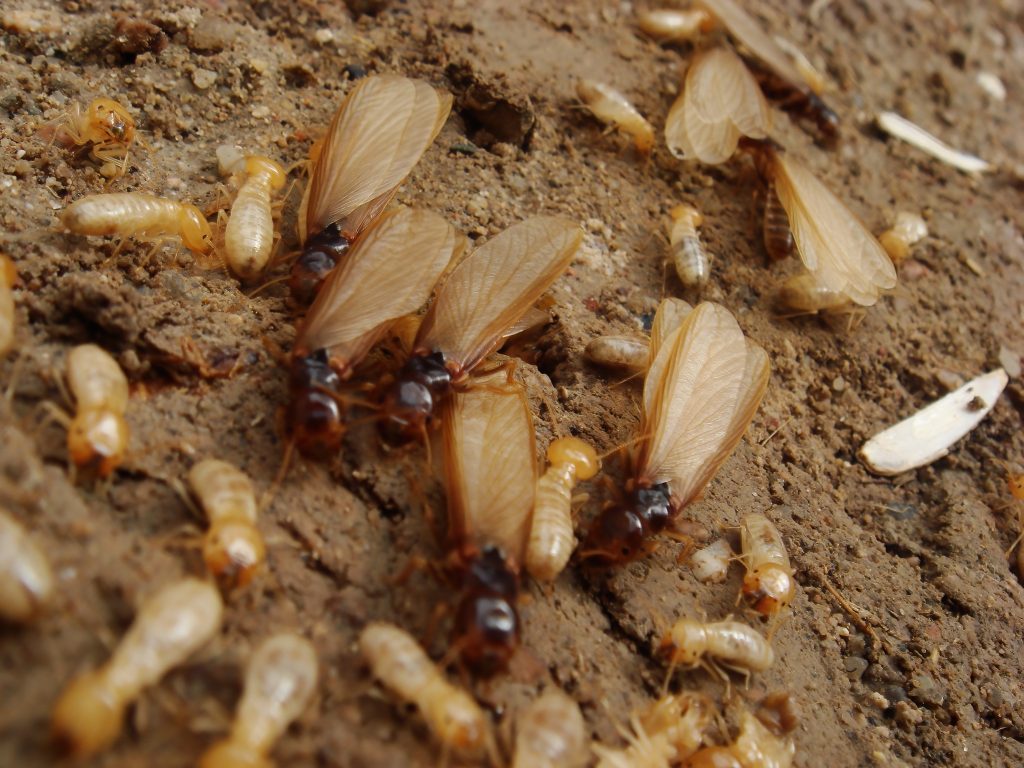
You open the patio door on a warm fall afternoon and notice thin wings scattered across the track. A few dark insects crawl along the glass while others circle the porch light. Termites with wings are leaving a mature colony nearby, and the location of that activity helps determine how concerned you should be.
A termite swarm over the yard could come from soil, a fence, a tree stump, or another property. Termites appearing inside a closed room or pushing through wooden trim point to a more immediate concern. This guide explains why early fall termite swarms happen, how to identify termite swarmers, which signs of termites matter, and when a professional termite inspection becomes the sensible next step.
Why Termites With Wings Appear in Early Fall
A termite colony does not release winged reproductives every day. It must be mature enough to produce them, and the weather must support a brief mating flight. Warm temperatures, calm air, higher humidity, and recent rain can bring those conditions together.
California does not have one fixed termite swarming season. Los Angeles and San Diego often stay warm and dry later into fall, while Walnut Creek and the San Francisco Bay Area may receive cooler weather and meaningful rain earlier. Two homeowners can therefore see flying termites weeks apart without either sighting being unusual.
Rain Can Trigger Subterranean Termite Swarms
Subterranean termites live below ground and rely on moisture. After autumn rain, winged termites can emerge through soil, cracks beside a slab, foundation gaps, or landscaped areas close to the house.
The University of California’s report on swarming termites in California explains that western subterranean termites often fly on calm, sunny days after the first fall rains. Because weather affects many colonies at once, several homes in the same neighborhood can experience a termite swarm on the same afternoon.
Drywood Termites Follow a Different Pattern
Drywood termites live inside wood and do not need contact with soil. Colonies can occupy attic framing, fascia boards, window trim, furniture, fences, and dead branches. Their hidden location means a burst of termite swarmers can be the first activity you notice.
The month of the sighting cannot identify the termite type by itself. Recent weather, the emergence point, nearby wood conditions, and other physical clues provide better information.
| Termite Group | Typical Colony Location | Property Clue | Fall Connection |
| Subterranean termites | Soil beneath or beside a structure | Earthen tubes or insects rising near a foundation | Warm conditions after rain can trigger flights |
| Drywood termites | Structural wood, furniture, fences, or dead branches | Pellets, discarded wings, or insects leaving wood | Some California populations swarm in late summer and fall |
| Dampwood termites | Wet, decaying, or heavily weathered wood | Soft lumber, leaks, or visible decay | Moisture matters more than a fixed calendar date |
What a Termite Swarm Says About Your Property
A swarm confirms that an established colony has produced reproductive termites. It does not give you the exact location of that colony. The insects can travel from surrounding soil, landscaping, fences, trees, nearby structures, or concealed areas of your own house.
Look first at where the activity began. Termites scattered around a bright exterior light could have flown from another part of the property. A dense group rising from one crack, foundation edge, or wooden frame gives you a more useful lead.
Outdoor Activity Requires Context
An outdoor swarm is worth recording, especially when it returns to the same location. Check the nearby area for old stumps, buried wood, fence posts, damp soil, wood touching the ground, and cracks near the foundation.
Do not assume the brightest gathering point is the source. Winged termites move toward light after emerging. The porch fixture, illuminated window, or open doorway may simply be where they ended up.
Termites With Wings in the House Raise the Stakes
Finding termites with wings in the house is more concerning when the room was closed. The insects may have emerged from a wall void, window frame, attic space, floor gap, or another concealed wooden area before moving toward the light.
One insect beside an open door may have entered from outside. Dozens of termite swarmers in a closed bedroom, hallway, or attic access area require a different response, especially when loose wings appear again in the same place.
| Sighting | What It Suggests | Practical Next Step |
| Termites crossing an open yard | A colony is active in the surrounding area | Note the direction and inspect nearby wood and soil |
| Insects clustered around a porch light | The light may have attracted swarmers from another location | Check for concentrated activity before sunset the next day |
| Swarmers on an interior windowsill | The insects could have emerged inside the room | Photograph the area and arrange a termite inspection |
| Termites leaving trim, flooring, or a wall crack | Activity could involve the structure | Avoid disturbing the opening and seek prompt evaluation |
| Fresh wings returning to the same room | More than one emergence event may have occurred | Save specimens and document each occurrence |
How to Tell Termite Swarmers From Flying Ants
Flying ants and termite swarmers often appear during the same warm, humid weather. Timing will not settle the question. A close look at the body gives you a more dependable answer.
A termite swarmer has a thick waist that continues through the center of its body. Its antennae look straight or gently curved. All four wings are close to the same length and usually extend beyond the abdomen.
A flying ant has a pinched waist and elbowed antennae. Its front wings are noticeably larger than the rear pair. Those differences are often visible in a clear phone photograph.
| Feature | Termite Swarmer | Flying Ant |
| Antennae | Straight or softly curved | Bent at a clear angle |
| Waist | Broad and uniform | Narrow and pinched |
| Wing size | Front and rear wings are similar | Front wings are larger |
| Overall shape | Thick through the center | Strongly segmented |
| Wings after landing | Often shed in matching piles | Less likely to leave equal-sized piles |
Do not use body color as your main test. Winged termites can appear tan, brown, dark brown, or nearly black. Flying ants also vary widely in color.
Take several close photographs before vacuuming or wiping the area. Try to capture the antennae, waist, and full wings. An intact specimen in a sealed container gives a technician more to work with during identification.
Which Signs of Termites Deserve Attention
The swarm tells you reproductive termites are active. The surrounding evidence helps determine whether they came from your home, nearby soil, or another piece of wood.
Drywood termites clear waste from their galleries through small openings. The material collects below infested wood as hard, evenly shaped pellets. Homeowners often find it below window frames, attic beams, baseboards, furniture, or door trim.
Subterranean termites create narrow earthen tubes between soil and wood. The tubes protect their soft bodies from dry air and predators. Check foundation walls, crawl space supports, slab edges, utility penetrations, and other sheltered areas near ground level.
The UC Statewide IPM reports that California’s most common drywood termite occurs along the Pacific coast, through parts of the Central Valley, and in Southern California. Colonies remain inside wood, so the visible surface can hide an active termite infestation.
Damage Does Not Always Look Dramatic
Termites often feed beneath an intact surface. Trim can appear normal while the inner wood has been thinned or hollowed. Finger pressure or a routine repair sometimes exposes damage that was not visible before.
Still, avoid diagnosing a termite infestation from one stain or crack. Moisture, wood-boring beetles, carpenter ants, aging paint, and normal building movement can create similar marks. A combination of discarded termite wings, pellets, tubes, softened wood, and repeated swarm activity carries more weight.
Moisture Can Change the Risk
Leaks and drainage problems make parts of a property more attractive to several termite groups. Inspect roof edges, plumbing areas, deck connections, crawl spaces, damaged gutters, and places where irrigation keeps the soil wet against the house.
Moisture correction protects the building even when termites are not present. It also removes conditions that support decay and other wood-damaging pests.
What to Do After You Find Flying Termites
Resist the urge to clean everything immediately. First, photograph the flying termites, loose wings, and the exact opening or surface where you found them. Record the time, weather, room, and whether nearby doors or windows were open.
Save two or three insects in a sealed bag or container. Then inspect the immediate area without pulling off trim, opening drywall, or breaking suspicious tubes. Disturbing the site can erase clues before anyone identifies the source.
A contact spray can kill swarmers on the floor or window, but those insects represent a small part of the colony. Surface treatment does not reach workers protected inside wood or underground.
The U.S. Environmental Protection Agency (EPA) states that termites cause billions of dollars in structural damage each year and that property owners spend more than $2 billion on treatment. The agency also notes that products which kill visible termites have not necessarily been shown to protect an entire structure.
Make the Property Less Favorable
Repair plumbing leaks, damaged gutters, and drainage problems that keep wood or soil wet. Move firewood, scrap lumber, cardboard, and dead branches away from exterior walls. Keep mulch and soil below the siding so the foundation remains visible.
These changes reduce favorable conditions, but they cannot confirm whether a colony already occupies the property. That question requires identification and a structured inspection.
Schedule a Termite Inspection Before Damage Spreads
Termites with wings leave you with three practical questions: Are the insects termites, where did they come from, and is your house involved? Waiting for another swarm rarely answers them. The visible insects can disappear within hours while colony activity continues inside soil or wood.
A professional termite inspection replaces guesswork with property-specific information. A technician can examine saved specimens, trace likely emergence areas, inspect accessible wood and foundation zones, and separate termite evidence from moisture damage or other pests. That process helps you avoid paying for the wrong treatment while a concealed problem remains untouched.
Round the Clock Pest Services works with homeowners across Los Angeles County, San Francisco, and the San Fernando Valley. Contact Round the Clock Pest Services when you find termites with wings in or around your home. A timely inspection can identify the likely source, clarify whether the structure is involved, and give you a clear next step before repairs become more extensive.