
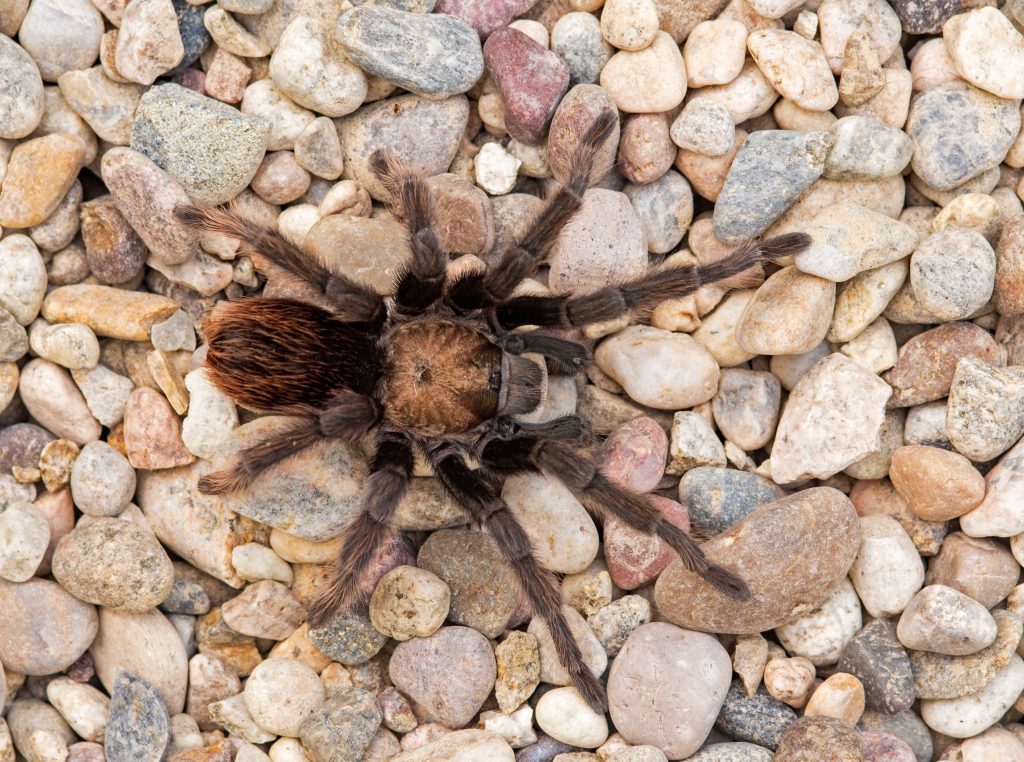
A large, hairy spider crossing your driveway is hard to ignore. You may see one near a garage, patio, hiking trail, or hillside home, especially as California moves from late summer into fall. Its size can make the encounter feel more serious than it is.
Tarantulas in California spend most of their lives out of sight. They shelter in burrows, hunt insects, and avoid unnecessary contact with people. The spiders seen walking through open areas are often mature males searching for females during mating season.
Knowing what you found helps you respond without getting too close. This guide explains California tarantula identification, habitat, seasonal behavior, feeding habits, health risks, and the right steps to take when one appears near your home.
How to Identify Tarantulas in California
Tarantulas in California have heavy bodies, thick legs, and a dense layer of hair. Their slow, deliberate walk also sets them apart from many household spiders that run quickly when disturbed. Most local tarantulas appear brown, black, gray, tan, or bronze, although sunlight, dust, age, and molting can affect their color.
A tarantula has two main body sections and eight legs. The front section holds the eyes, mouthparts, fangs, and legs. The rounded abdomen sits behind it. Their leg span creates much of their apparent size, so a tarantula may look much larger than its actual body length.
| Feature | California tarantula | Common house spider | Black widow |
| Overall build | Large, broad, and heavy | Usually small or lightly built | Small body with long, slender legs |
| Body covering | Dense, visible hairs | Fine hairs may be hard to see | Smooth, shiny abdomen |
| Common colors | Brown, gray, black, tan, or bronze | Brown, gray, yellow, or patterned | Glossy black, often with red markings |
| Typical movement | Slow unless strongly disturbed | Often quick or erratic | Usually remains near its web |
| Web or shelter | Burrow lined with silk | Irregular web, funnel, or hiding place | Strong, messy web in a protected area |
| Usual location | Ground, foothills, yards near open land | Walls, ceilings, garages, and storage areas | Garages, woodpiles, sheds, and protected corners |
California’s native tarantulas are generally classified within the genus Aphonopelma. Species in this group can look very similar. Color alone may not separate one species from another, and a photo may only support a general tarantula identification.
The California ebony tarantula and San Diego bronze tarantula are two names associated with Southern California. Still, homeowners should avoid assigning a species based only on a dark body or bronze-colored hairs. Location, anatomy, and other evidence may be needed for a firm scientific identification.
Male and Female Tarantulas Behave Differently
The tarantula crossing a road, trail, or backyard is often male. Mature males tend to have longer-looking legs and slimmer abdomens than females. Once they reach maturity, they leave protected areas and walk through the landscape in search of female burrows.
Females are heavier and more closely tied to established shelters. They may sit near the burrow entrance after dark and wait for prey to move within reach. When they detect strong vibrations, they usually retreat underground rather than remain exposed.
| Trait | Mature male | Adult female |
| Body shape | Slimmer abdomen and longer-looking legs | Broader abdomen and heavier build |
| Surface activity | More likely to wander in the open | Usually stays near a burrow |
| Main seasonal behavior | Searches for a mate | Waits in or near an established shelter |
| Chance of a yard sighting | Higher during mating season | Lower unless the burrow is nearby |
| Adult lifespan | Much shorter after maturity | Commonly lives well over a decade |
Female tarantulas can live for many years. The University of California Agriculture and Natural Resources reports a lifespan of about 13 to 15 years for many female California tarantulas. Mature males have much shorter adult lives after they begin their search for mates.
This difference explains why seasonal sightings often involve males. It does not mean females have disappeared or that the entire local population has started moving. Most females remain hidden where homeowners rarely see them.
Where California Tarantulas Live
California tarantulas favor dry environments with soil or natural openings that provide stable shelter. They live in grasslands, chaparral, foothills, desert edges, rocky slopes, and open oak woodland. Properties bordering undeveloped land may also support tarantulas nearby.
A burrow protects the spider from daytime heat, cold nights, predators, and moisture loss. Some tarantulas dig into suitable soil. Others use cracks beneath rocks or enlarge holes left by small animals. Silk placed around the shelter can reinforce the opening and help the spider detect nearby movement.
You are more likely to encounter a tarantula near inland hills and open spaces than in a dense urban center. Southern California foothill communities, dry parts of San Diego County, the Santa Clarita Valley, Mount Diablo, and areas near Pinnacles National Park all offer some combination of warm temperatures, open land, and suitable ground cover.
One tarantula in a yard does not point to a nest or colony. Tarantulas do not live in organized social groups. A spider may simply be passing through a property that lies between patches of natural habitat.
What Tarantulas Do Inside Their Burrows
A tarantula burrow is more than a hiding hole. It provides a stable place to rest, molt, avoid predators, and wait for food. A female may remain associated with the same shelter for years if the location continues to protect her.
Tarantulas use silk differently from orb weavers and other web-building spiders. They do not suspend a round web between plants to catch flying insects. Instead, they may line the burrow and place silk near the entrance. Vibrations traveling through that material can alert the spider to prey or danger.
Molting also takes place in a protected setting. A growing tarantula must shed its old exoskeleton and form a new one. During this process, the spider is soft and vulnerable, so an undisturbed retreat is essential.
An apparently empty hole near a slope or foundation should not be probed by hand. You may not be able to see the spider from the entrance. Other animals can also use ground openings, making a visual inspection from a safe distance the better choice.
Tarantula Feeding and Hunting Habits
Tarantulas are ambush predators. They wait for prey to come close, detect its movement through sensitive hairs, and strike from a short distance. Their diet mainly consists of insects and other arthropods that they can overpower.
Crickets, beetles, grasshoppers, cockroaches, and smaller spiders can all become prey. A tarantula uses its fangs to deliver venom and digestive fluids. It then consumes the broken-down tissue in liquid form.
This feeding behavior gives outdoor tarantulas a place in California’s natural pest-control system. They consume insects without damaging houses, landscaping, or stored food. A tarantula passing through a yard is not trying to establish itself in a kitchen or pantry.
Tarantulas also serve as food for other animals. Birds, reptiles, mammals, and specialized wasps may prey on them. The tarantula hawk wasp is known for paralyzing a tarantula and using it to feed a developing larva.
When Tarantula Season Starts in California
Tarantulas remain hidden during much of the year, so the sudden appearance of large spiders can feel like a population surge. In most cases, the visible activity comes from mature males looking for females.
Timing changes by region, elevation, temperature, and seasonal weather. Warmer parts of Southern California may see male movement begin in August. September and October usually bring more sightings across central and northern locations.
The National Park Service identifies September and October as prime viewing months for male tarantulas at Pinnacles National Park. Males may walk during daylight or after dark as they search for female burrows.
| Time of year | Typical tarantula activity | What homeowners may see |
| Winter | Most activity remains underground | Few outdoor sightings |
| Spring | Feeding and growth continue near shelters | Occasional activity near a burrow |
| Early summer | Spiders avoid extreme surface heat | Limited daytime movement |
| Late summer | Mating-related movement may begin | Males crossing yards, trails, or roads |
| September and October | Male activity is often most noticeable | Increased open-ground sightings |
| Late fall | Surface activity declines as conditions cool | Fewer wandering tarantulas |
The phrase “tarantula migration” appears in news coverage, but it can be misleading. These spiders are not traveling as one coordinated group. Individual males are moving through the same type of habitat during the same seasonal window.
Are California Tarantulas Dangerous?
Tarantulas have venom because they need it to capture prey. That does not make California species a major threat to people. A tarantula generally relies on retreat and defensive displays before biting.
When threatened, it may raise its front legs or turn toward the disturbance. Some New World tarantulas can also brush tiny defensive hairs from the abdomen. These hairs may irritate skin, eyes, or airways, which is one reason you should never handle a wild tarantula.
According to Poison Control, bites from North American tarantulas generally cause mild local symptoms, while defensive hairs may produce redness, itching, swelling, or eye irritation. Eye exposure deserves prompt medical guidance because rubbing can push the hairs deeper into sensitive tissue.
Keep children and pets several feet away from any tarantula you find. A curious dog may sniff, paw, or bite at the spider, triggering a defensive response. A child may also try to touch the hairs without understanding the risk.
Wash a suspected bite with soap and water. Do not rub an exposed eye. Seek medical care for breathing difficulty, spreading swelling, severe pain, eye exposure, or signs of an allergic reaction.
Why Tarantulas Sometimes Enter California Homes
Tarantulas are not well adapted to living inside occupied homes. They do not seek human food, fabric, or mattresses. Indoor sightings usually happen when a wandering spider slips through an open door or an unsealed gap.
Garage doors are a common access point. Worn bottom seals and open corners can leave enough space for a large spider. Gaps under exterior doors, damaged window screens, and openings around pipes or utility lines can create similar routes.
Exterior lighting may also influence activity near an entrance. Bright lights draw moths, beetles, and other insects. Spiders may follow that food activity toward doors, patios, or garages even when they have no reason to remain inside.
Storage clutter gives an accidental visitor a place to hide. Cardboard boxes, unused equipment, and items stacked against garage walls make inspections harder. Clear floor edges allow you to notice spider activity before it reaches the living area.
What to Do When You Find a Tarantula
When the tarantula is outdoors and moving away from occupied areas, give it room to leave. Bring pets inside and ask children to stay back. Spraying or striking the spider can provoke a defensive response without solving a property problem.
If a tarantula enters a room, close interior doors to limit its movement. You may place a wide container over it and slide stiff cardboard underneath, but only when you can do so without direct contact. Wear closed shoes and gloves, and keep your face away from the container.
Do not attempt removal when the spider is behind furniture, inside a wall opening, or in another location that puts your hands close to it. The same applies when you cannot confirm what type of spider you found. California homes may attract several large spider species, and not every dark spider is a tarantula.
After the spider is gone, check the building instead of treating the incident as random. Inspect door sweeps, garage seals, screens, vents, and utility openings. Look for insect activity near exterior lights and remove clutter from garage walls. These steps address the conditions that allowed the spider to reach the structure.
Keeping Tarantulas and Other Spiders Outside
A single outdoor tarantula rarely calls for property-wide treatment. Repeated indoor spider sightings are different. They can point to open entry routes, abundant insect prey, or protected hiding areas around the building.
Round The Clock Pest Services checks doors, windows, foundations, eaves, garages, and other common access points. The goal is to find where spiders and their prey are getting close to the home, then address those conditions without treating harmless outdoor wildlife as an infestation.
Tarantulas in California are part of the state’s natural landscape. You can avoid most problems by keeping your distance, maintaining exterior seals, and reducing the insects that gather around entryways. When a large spider gets inside or sightings keep happening, a local pest professional can help you identify the cause and decide what the property needs.